happy xiao 的频道
我是 happy,你可以在 aa.ee 了解我更多
- Where does this leave us? It’s becoming increasingly clear that the right question regarding productivity is not whether it’s good or bad, as it’s both a reflection of our humanity and a target for exploitation. The better query is how we can more fully reclaim it — to build a life that enjoys the pleasures of accomplishments while avoiding the sting of overload and burnout. - Cal Newport
via idea.cc (author: happy) - What you’ve just read, by the way, could be called an “essay”, a “blog post”, a “rant”, an “article,” “a completely misguided overreaction,” or plenty of other things.
Just do not, I beg of you, call it “content”.
via Clive Thompson
via idea.cc (author: happy) - You see now how some people make it to midlife and implode. You think the discipline will add up to something but what if it doesn’t. And what if it adds up to the wrong thing. What if one day you have the house and the boy and the baby and the book and you realize it’s no solace in the face of your own mortality.
It’s just like you to believe that good behavior will always be rewarded. It’s just like you to believe that meaning is something that can be earned. You’re getting old enough to see the holes in your own logic. You poke fingers through. It’s kind of funny in the Kafka sense of the word. via
via idea.cc (author: happy) - The Dokkōdō 獨行道
The 21 principles of Dokkodo:
1. Accept everything just the way it is.
2. Do not seek pleasure for its own sake.
3. Do not, under any circumstances, depend on a partial feeling.
4. Think lightly of yourself and deeply of the world.
5. Be detached from desire life long.
6. Do not regret what you have done.
7. Never be jealous.
8. Never let yourself be saddened by a separation.
9. Resentment and complaint are appropriate neither for oneself nor others.
10. Do not let yourself be guided by the feeling of lust or love.
11. In all things have no preferences.
12. Be indifferent to where you live.
13. Do not pursue the taste of good food.
14. Do not hold on to possessions you no longer need.
15. Do not act following customary beliefs.
16. Do not collect weapons or practice with weapons beyond what is useful.
17. Do not fear death.
18. Do not seek to possess either goods or fiefs for your old age.
19. Respect Buddha and the gods without counting on their help.
20. You may abandon your own body but you must preserve your honor.
21. Never stray from the Way.
via idea.cc (author: happy) - the second arrow problem: Anytime something bad happens, it's like we're being hit by two arrows. The first arrow is the painful thing that happened; the second is our reaction to that bad thing. In other words, problems (the first arrow) are inevitable, but suffering (the second arrow) is optional. The events will happen. The first arrows fall on everyone. But if we suffer about the suffering, we are throwing a second arrow at ourselves, and it's always a double hitter. via
via idea.cc (author: happy) - 地热辐射当然也是形成生命的重要条件,但我说的是开启碳基生命进化的那把关键钥匙,即太阳能。像木卫二那么远,如果真有生命,那也只可能是苟活在深海火山口的单细胞生物(细菌)。生命要想进化出复杂的形态,以及营造丰富的生态,高效的能量转化就不可或缺。
打个不恰当的比方,生命如同一台汽车,各类辐射如同汽油,能量转换就是发动机,缺少发动机,生命就是一堆毫无生气的废铁。而对于地球上的生命来说,最开始的那台让生命跑起来的发动机,就是光合作用。当然,这里讨论的生命体只限于碳基生命,硅基生命或者有意识的纯能量体不在讨论范围之内。
抛开人类的生命观,我觉得各种星球本质上也是一种“生命”,你能说木卫二是死的吗?当然不能,刮在它表面的每一次风暴,就是木卫二的一次呼吸。可能在无限宏观的环境下,所谓的生命就是无意识的超级星体,只有宇宙微观下的人类,才会冥思苦想自己到底是谁,外面到底有什么。如果人类有一天洞悉了宇宙的一切,进化成了“神”,那么它就不需要有意识了,它所有的行为都会遵循宇宙本身的意志,超脱生于死的物理法则,消散于多维时空中,成为宇宙的本身。 - “The creative process is a process of surrender, not control.”
— Bruce Lee
via idea.cc (author: happy) - 你应该与她做的事情

散步永远不会后悔,尤其是和家人一起散步。这对身体、心灵和人际关系都大有裨益。
前两天,JR 说在学校填了一个问卷调查,主题是心理健康。其中有一题,需要学生回答与父母的关系。他妈马上问他:“填的什么?”他说,填的“非常好”。我在一旁听到了,心头感觉一丝丝温暖和欣慰。不管在即将到来的青春期里,我们父子俩的关系是否还能维系在“非常好”的程度,至少目前为止,我做得还不错。
在与 JR 相处过程中,我犯了许多错,也做对了一些事情。在值得延续的事情里,我首先想到的是,时常和他散步。如果有个增进关系的行动排行榜的话,这件事也许可以排在第一位。
散步为什么这么有效?我估摸有这些原因:
Read more
via 可乐周报 (author: happy xiao) - 值得抱怨的,都是机会
如果别人小人
我们有机会君子
如果别人浮躁
我们有机会沉静
如果别人短视
我们有机会远见
如果别人中庸
我们有机会绽放
如果别人盲从
我们有机会出众
via idea.cc (author: happy) - Chandler explained: “The important thing is that there should be a space of time time, say four hours a day at least, when a writer doesn’t do anything else but write. He doesn’t have to write, and if doesn’t feel like it, he shouldn’t try. He can look out the window or stand on his head or writhe on the floor. But he is not to do any other positive thinking—not read, write letters, glance at magazines, or write checks. Either write or nothing.” Either write or random episodic silent thought. When those are your only options, Chandler said, you will write “just to keep from being bored. I find it works. Two very simple rules: a. You don’t have to write. b. You can’t do anything else.” via
via idea.cc (author: happy) - 我如何用 Readwise Reader 阅读(上)
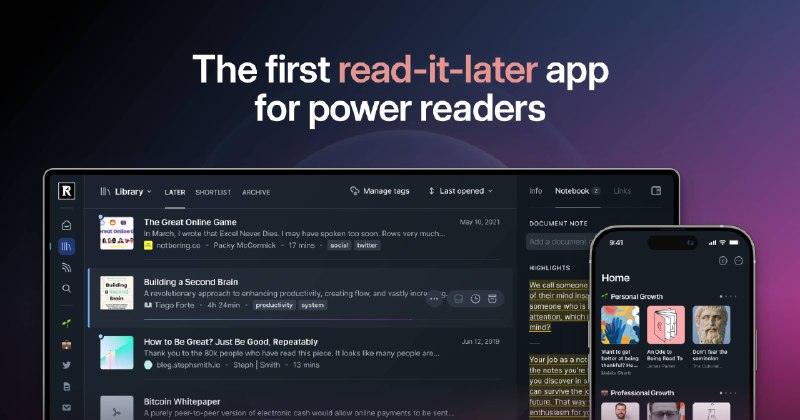
每一天,我用 Readwise Reader 阅读和标记,它是我离不开的软件。
当我用得多了,自然有些心得可以分享。于是,打算用两篇博客,告诉你我怎么使用 Reader,以及我有哪些小技巧。为了避免让你感觉无聊,你可以用这个链接注册,免费使用60天,然后在文章底部找到我订阅的73个博客的清单文件,导入到你注册好的 Reader 里,顺着我的文章,自己操作试试看。
我在 Reader 里读什么
除了 Kindle,我只用 Reader 阅读,也就是说,我用它读所有东西。
包括:
● 通过 RSS 订阅的博客
● 通过 Reader 的邮件地址订阅的 newsletter
● 随时添加进去的网络文章
● 长推文、推文串
● YouTube 视频(它可以让你边看视频边读转录文字)
● 电子书、PDF
我已经养成了习惯,只要是超过一个推文长度的文字,全部从 Reader 上阅读。这么做的原因有三个:一,Reader 的阅读体验更好;二,读完了自动存档,需要时可以通过元数据或标签筛选,也可以被直接搜索;三,我可以随时高亮和笔记。
我如何添加内容
Read more
via 可乐周报 (author: happy xiao) - 中国有一句谚语说,“金刚怒目,不如菩萨低眉”。所谓怒目,便是流露;所谓低眉,便是含蓄。凡看低头闭目的神像,所生的印象往往特别深刻。 - 朱光潜《无言之美》
via idea.cc (author: happy) - That's the way creativity works, Dylan told Robert Hilburn, of the Los Angeles Times. You're always writing into a tradition. "My songs are either based on old Protestant hymns or Carter Family songs or variations of the blues form," he said. "What happens is, I'll take a song I know and simply start playing it in my head. That's the way I meditate. . . . I'll be playing Bob Nolan's 'Tumbling Tumbleweeds,' for instance, in my head constantly--while I'm driving a car or talking to a person or sitting around or whatever. People will think they are talking to me and I'm talking back, but I'm not. I'm listening to a song in my head. At a certain point, some of the words will change and I'll start writing a song." via
via idea.cc (author: happy) - 我们家基本上不开电视,晚上也没人抱着手机和iPad(有时还是会瞅一眼),JT 和他哥小时候不一样,也就没有看电视和手机iPad的习惯,晚上玩玩积木,和我玩玩球,或是我抱着他讲讲故事,这样很好。JR呢,写完作业就弹琴,和弟弟玩,或者边听HomePod里的音乐,边和我们聊天。
如果电视手机突然从所有家庭消失,每个人的幸福感都会增加,我想。
via idea.cc (author: happy)